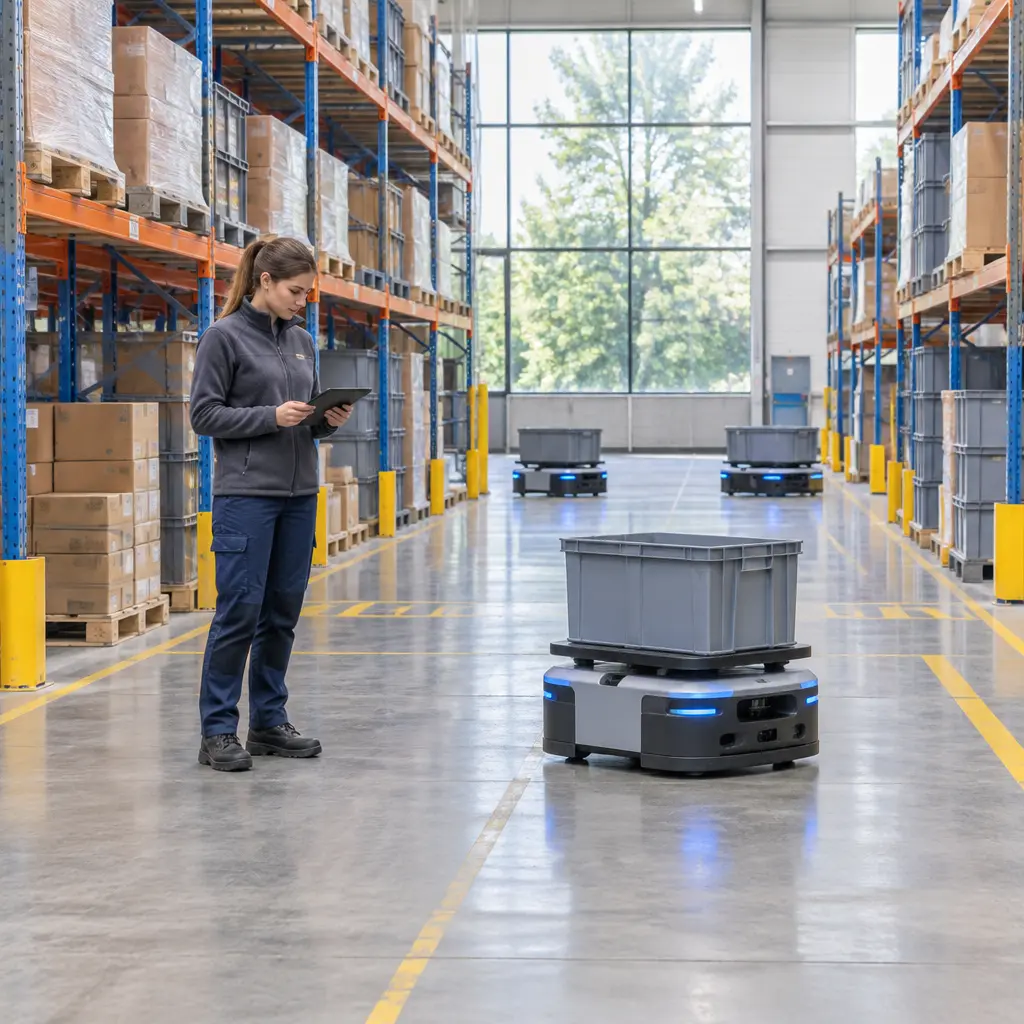
Warehouse robots are machines that move goods, assist with picking, sort packages, or replenish stock in distribution facilities. They are changing warehouse work, but current evidence does not support a simple conclusion that they will replace all warehouse workers: automation is more likely to take over particular repetitive tasks, reshape many jobs, and create demand for workers who can operate, maintain, and supervise technology. The effects depend on the task, the facility, and the pace of investment. The International Federation of Robotics reported 86,000 professional service robots for transportation and logistics sold worldwide in 2023, while U.S. Bureau of Labor Statistics projections indicate continued demand for hand laborers and material movers through 2033. Together, these trends make the central question less “robots or people?” than “which tasks will change, and how will workers share the gains?”
Warehouse automation and its effect on workers
Warehouse automation is the use of equipment and software to perform or coordinate activities such as transporting, storing, identifying, retrieving, and sorting goods. The International Federation of Robotics describes logistics robots as professional service robots used to transport goods or cargo. In practice, the category includes autonomous mobile robots (AMRs), automated guided vehicles (AGVs), robotic picking systems, conveyor and sortation equipment, and software that assigns or tracks work.
These technologies differ in how much human involvement they require. An AGV usually follows a predefined route or guidance system; an AMR can navigate dynamically around people and obstacles. A goods-to-person system brings shelves, bins, or items to a worker, while a robotic arm may identify and grasp individual products. Automation can therefore remove walking or lifting from a job without eliminating the worker’s role in inspection, exception handling, replenishment, or problem-solving.
Transport and mobile robots
Transport robots move inventory, totes, or pallets between storage, picking, packing, and shipping areas. In its World Robotics 2024 report, the International Federation of Robotics said sales of professional service robots for transportation and logistics reached 86,000 units in 2023, up 35% from the previous year. This figure reflects worldwide sales across relevant logistics applications, not the number of robots installed in warehouses alone.
Mobile robots can reduce time spent pushing carts or walking long distances, but they still need people to load and unload items, handle damaged goods, and respond when routes or inventory records are wrong. Their employment effect is thus linked to the work system around them: a robot that carries a tote changes the physical demands and pace of a task, while a fully automated storage and retrieval system may reduce the number of people needed for some movements.
Picking, sorting, and packing systems
Picking systems retrieve products to fulfill orders; sorting systems direct items to the correct destination; and packing systems prepare orders for shipment. Robots can perform these tasks when items are predictable and easy to grasp, while people remain valuable for irregular, fragile, unfamiliar, or poorly presented products. Even advanced systems commonly rely on human workers to clear jams, verify exceptions, replenish supplies, and check quality.
The distinction matters because “a warehouse job” is a bundle of tasks rather than one indivisible activity. A robot may automate scanning or repetitive conveyance while leaving judgment-heavy work in place. The more variable the inventory and the less standardized the facility, the harder it can be to automate every step economically and reliably.
Warehouse robots and employment outcomes
Employment outcomes are the changes in the number, type, and quality of jobs associated with introducing automation. The Organisation for Economic Co-operation and Development emphasizes that automation exposure is not the same as certain job loss: technologies affect tasks, and occupations usually contain a mix of tasks with different levels of automability. This distinction helps explain why a robot can displace some duties while changing or complementing the rest of a worker’s job.
For context, the U.S. Bureau of Labor Statistics counted about 6.1 million people employed as hand laborers and material movers in 2023. Its Occupational Outlook Handbook projects employment in this broad occupation to grow 4% from 2023 to 2033, approximately as fast as the average for all occupations. This national projection is not a forecast of warehouse automation’s isolated effect, and the occupational category includes workers outside warehouses. It does, however, show why claims that robots will eliminate material-moving work altogether are not supported by the projection.
Task displacement and job redesign
Task displacement occurs when machinery performs duties previously done by people. In warehouses, this can include moving standardized loads, scanning barcodes, or sorting parcels at high speed. Job redesign occurs when remaining workers take on different duties, such as monitoring robot performance, resolving inventory exceptions, or servicing equipment.
The World Economic Forum’s Future of Jobs Report 2025 identifies robotics and automation among technologies expected to change work through 2030, while also reporting that employers anticipate both job creation and job displacement across the wider economy. Those findings are employer expectations, not a specific count of warehouse positions that robots will replace. They reinforce the need to distinguish changes in tasks from changes in total employment.
Productivity, demand, and new roles
Productivity gains can affect employment in more than one direction. If automation lowers fulfillment costs or makes faster delivery possible, a business may expand and need more workers in customer service, inventory control, maintenance, or shipping. If a facility handles the same volume with fewer labor hours, it may reduce hiring or staffing. Which effect dominates depends on demand, costs, competition, and how quickly the organization grows.
Automation also creates or expands roles in robotics maintenance, controls engineering, systems integration, data analysis, and safety supervision. Not every displaced worker can move directly into these positions: they may require technical training, certifications, or different experience. Employers and educators therefore influence whether new roles provide realistic pathways for existing warehouse staff.
Warehouse robots and worker safety
Worker safety is the prevention of injuries and health risks arising from warehouse tasks, equipment, and the work environment. Robots may reduce exposure to heavy lifting, repetitive carrying, and some forms of manual handling. At the same time, they introduce risks involving collisions, pinch points, unexpected movement, and interaction between people and mobile machinery. Automation changes the safety profile; it does not automatically make a workplace safe.
Physical strain and ergonomic benefits
When robots bring goods to a worker or transport heavy loads, they can reduce walking and manual carrying. This may lessen physical strain, particularly in operations with repetitive movement or heavy items. The benefit depends on the design of the whole job: a system that reduces travel but increases picking speed or repetitive reaching may shift rather than remove ergonomic stress.
New hazards and safety controls
Mobile robots and automated machinery create hazards that require traffic management, guarding, emergency stops, training, maintenance, and clear procedures for faults. The U.S. Occupational Safety and Health Administration advises employers to assess robotic-system hazards and use appropriate safeguards, including measures to protect workers from unexpected operation and hazardous work zones. Facilities should also evaluate how sensors, alarms, pedestrian routes, and robot speeds work under real operating conditions—not just during installation.
Warehouse automation and the skills workers need
Workforce adaptation is the process of helping people learn the skills and access the opportunities required as jobs change. As warehouses adopt connected equipment, workers may need digital literacy, familiarity with warehouse management systems, basic troubleshooting, and the ability to interpret alerts or instructions from automated equipment. Technical roles may require more specialized training in electronics, mechanical systems, programming, or controls.
Training and advancement pathways
Effective training connects technology adoption to practical career pathways. Employers can offer paid instruction, mentoring, equipment-specific credentials, and opportunities for experienced warehouse employees to move into maintenance or supervisory work. Community colleges and workforce agencies can support this process with programs in industrial maintenance, mechatronics, and logistics technology. Training is most useful when it is available before job duties change and when workers can participate without losing income.
Job quality and worker voice
Job quality includes pay, stability, safety, autonomy, workload, and opportunities to progress. Automation can make work less physically demanding, but software-based performance monitoring and faster production targets may also intensify pressure. Workers should be involved in decisions about system design, safety, work rates, and retraining because they understand operational bottlenecks and the practical effects of new technology.
Warehouse robots and real-world adoption
Real-world adoption is shaped by facility layout, product variety, labor availability, capital costs, and the reliability of the technology. Amazon’s warehouse operations provide a prominent example: the company has publicly described using mobile robots to transport shelves and inventory while human employees perform tasks such as picking, packing, and handling exceptions. This illustrates a common pattern of human-machine collaboration, although practices differ across sites and the company’s description should not be treated as evidence that every facility has the same results.
A useful comparison for readers is a simple before-and-after chart showing walking distance, units handled per hour, injury rates, headcount, downtime, and training hours. Those measures help distinguish genuine productivity improvements from a mere shift in work intensity or costs. Results should be interpreted alongside changes in order volume and product mix, since those factors can affect both staffing and performance.
Will robots replace warehouse workers?
Robots will replace some warehouse tasks and may reduce demand for particular kinds of labor in highly automated facilities, but available evidence does not show that they will replace warehouse workers as a whole. The scale and timing of change will vary by task, company, and region. Mobile transport and standardized sorting are easier to automate than work involving irregular products, exceptions, judgment, or equipment troubleshooting.
The key implications are practical: employers should measure the effects of automation on jobs and safety, make retraining accessible, and involve workers in implementation. Workers can explore training in maintenance, logistics technology, and equipment operation, while policymakers and educators can strengthen affordable routes into these fields. Further reading from the International Federation of Robotics, the U.S. Bureau of Labor Statistics, OSHA, and the Organisation for Economic Co-operation and Development can help readers assess new claims about robotics and work.
Sources: International Federation of Robotics, World Robotics 2024: Service Robots, https://ifr.org/ifr-press-releases/news/service-robots-see-30-percent-growth-worldwide; U.S. Bureau of Labor Statistics, Occupational Outlook Handbook: Hand Laborers and Material Movers, https://www.bls.gov/ooh/transportation-and-material-moving/hand-laborers-and-material-movers.htm; Organisation for Economic Co-operation and Development, OECD Employment Outlook 2023: Artificial Intelligence and the Labour Market, https://www.oecd.org/en/publications/oecd-employment-outlook-2023_08785bba-en.html; World Economic Forum, The Future of Jobs Report 2025, https://www.weforum.org/publications/the-future-of-jobs-report-2025/; U.S. Occupational Safety and Health Administration, Robotics, https://www.osha.gov/robotics; Amazon, Robotics at Amazon, https://www.aboutamazon.com/news/operations/amazon-robotics-robots-fulfillment-center