
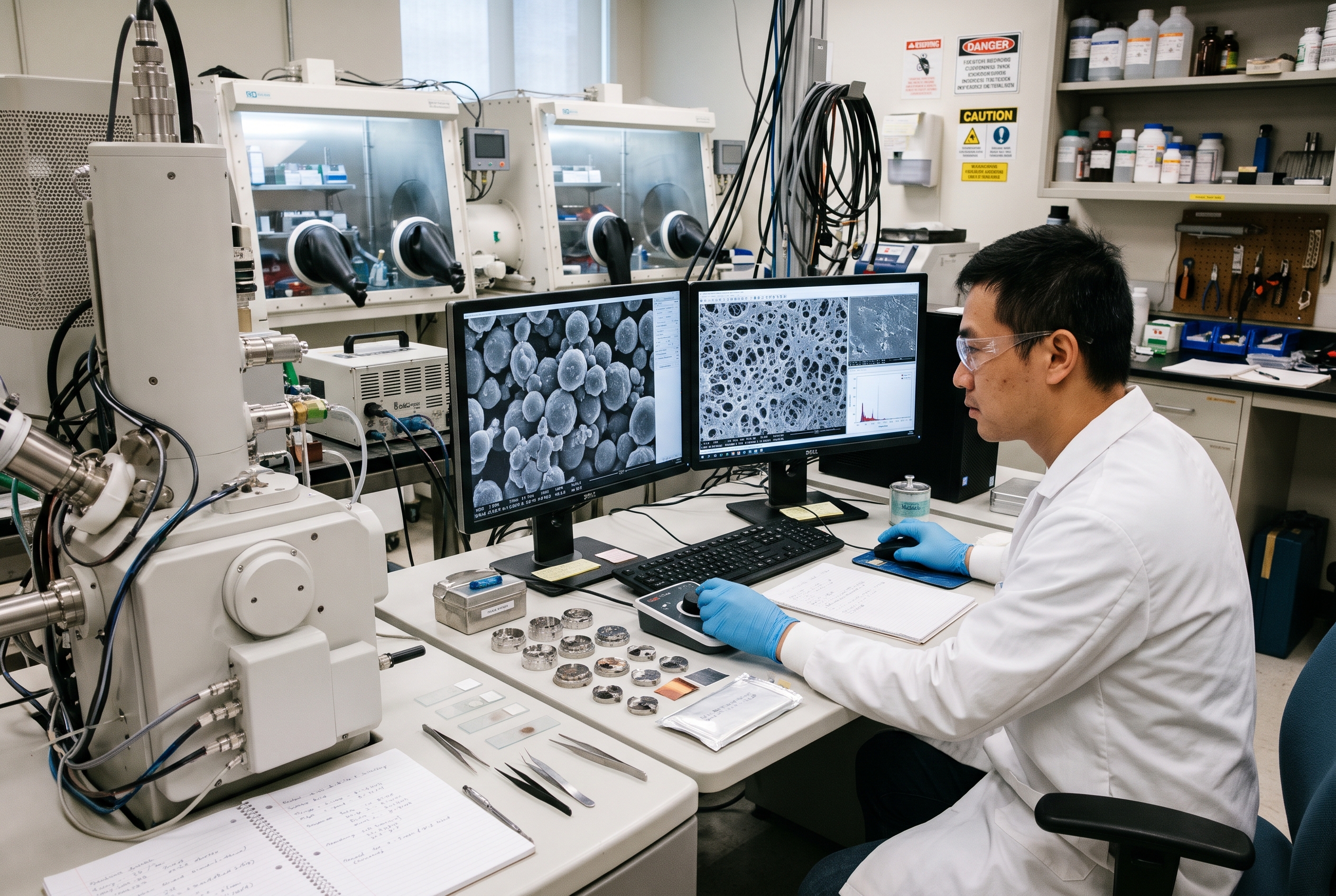
As automotive engineering shifts toward high range electric mobility, the performance and safety of lithium ion traction batteries depend heavily on material structure at the microscopic level. Subtle variations in electrode powder shape, binder uniformity, or separator pore distribution can dramatically shorten driving range, slow charging rates, or trigger dangerous internal thermal events. Scanning electron microscopy analysis delivers ultra high resolution imaging and localized elemental diagnostics that allow battery engineers to inspect active cell materials down to the nanometer scale. By visualizing hidden microstructural flaws before cells enter mass module assembly, manufacturers ensure consistent energy density and dependable long term operational safety.
Standard optical microscopes lack the depth of field and magnification needed to resolve submicron electrode coatings or fragile polymer separator webs. Direct electron beam imaging bridges this analytical gap, giving research and quality assurance teams clear visual evidence to refine cell chemistry and validate raw material suppliers.
Microstructural Battery Characteristics Evaluated Under Electron Beams
Inspecting battery components in both pristine and cycled states uncovers vital structural parameters that govern real world vehicle performance.
- Cathode and Anode Active Particle Morphology: The charging efficiency and mechanical stability of nickel manganese cobalt, lithium iron phosphate, and graphite electrodes rely on uniform particle size and smooth surface coatings. Electron micrographs reveal premature particle cracking, uneven conductive carbon dispersion, and binder delamination across metallic current collector foils.
- Microporous Polymer Separator Integrity: Ultra thin polyolefin and ceramic coated separators physically isolate positive and negative electrodes while permitting rapid lithium ion flow. High magnification surface inspection verifies consistent pore geometry and detects thermal shrinkage, ceramic flaking, or pinhole defects that could initiate internal electrical shorts.
- Lithium Dendrite Growth and Aging Forensics: Aggressive fast charging and subzero ambient operation can force metallic lithium to plate out as sharp, needle like dendrites across the anode surface. Forensic microscopy captures dendritic penetration and uneven solid electrolyte interphase buildup to explain unexpected battery capacity fade.
Automotive Electrification Sectors Applying Electron Imaging
High precision microstructural auditing supports yield optimization and safety certification across the electric vehicle supply chain.
- Traction Battery Cell Manufacturing: Production engineers inspect cross sections of calendered electrode sheets to measure exact coating thickness, porosity gradients, and interfacial contact between active layers and copper or aluminum foils.
- Power Electronics and Silicon Carbide Inverters: High voltage traction inverters endure intense switching heat and rapid thermal cycling. Cross sectional electron imaging uncovers microscopic voids in sintered silver die attach layers, wire bond heel fatigue, and ceramic substrate cracking.
- Thermal Interface and Busbar Coating Suppliers: Silicone gap fillers, structural potting compounds, and dielectric powder coatings shield battery modules from heat accumulation and electrical arcing. Backscattered electron imaging confirms homogeneous ceramic filler distribution without trapped insulating air bubbles.
- Battery Recycling and Raw Powder Qualification: Hydrometallurgical processors evaluate recovered cathode precursors and black mass materials to verify impurity removal and consistent spherical morphology before reentering automotive battery production.
Validating battery materials and high voltage electronic joints through rigorous microstructural inspection protects electric mobility brands from costly thermal recalls and premature warranty replacements. By scheduling accredited scanning electron microscopy analysis through an Alstesting automotive laboratory Malaysia, battery component suppliers and electrified vehicle assemblers secure authoritative analytical insights to meet global quality standards across Southeast Asia.
Frequently Asked Questions (FAQ)
How does electron microscopy measure electrode coating thickness accurately?
Analysts prepare crisp cross sections using specialized broad ion beam milling rather than mechanical blade cutting, which can smear soft graphite and polymer binders. Placing the ion milled edge under the electron beam provides a distortion free view of every internal layer, enabling precise digital thickness measurements from the metallic foil up to the active coating surface.
Why must air sensitive lithium battery samples be transferred carefully into the microscope?
Cycled lithium ion electrodes and residual electrolytes react almost instantly with ambient atmospheric moisture and oxygen, altering their original surface chemistry within seconds. Laboratories utilize sealed inert gas transfer vessels filled with argon to carry prepared cell samples directly from an environmental glovebox into the microscope vacuum chamber without air exposure.
What elemental data does EDX add when inspecting battery separator contamination?
While high magnification imaging exposes tiny foreign particles embedded inside a polymer separator, Energy Dispersive X ray Spectroscopy identifies their exact chemical makeup instantly. Detecting stray iron, copper, or zinc shavings pinpoints whether contamination originated from worn factory mixing blades, slitting knives, or impure raw chemical precursors.


