Warehouse automation combines software, machines, and data systems to move, store, pick, pack, and track goods with less manual intervention. It matters today because warehouses face pressure to fulfill orders faster, manage labor constraints, and handle growing operational complexity. Automation ranges from warehouse management software and barcode scanning to autonomous mobile robots and automated storage systems; its value depends on selecting tools that fit the work, integrating them safely, and measuring results such as productivity, accuracy, and order turnaround.
Warehouse automation improves the movement and control of goods
Warehouse automation is the use of technology to perform or support warehouse processes with reduced reliance on manual tasks. The term covers both physical equipment and digital systems: a conveyor moves cartons, for example, while warehouse software directs where inventory should go. The International Federation of Robotics describes logistics robots as systems used to transport and handle goods in settings such as warehouses, while the U.S. Occupational Safety and Health Administration emphasizes that material-handling hazards include risks from lifting, pushing, pulling, and repetitive work. Together, these perspectives show why automation is both an operational strategy and a workplace-design decision.
The need is evident in the scale of logistics. The U.S. Bureau of Labor Statistics reported approximately 1.8 million people employed as hand laborers and material movers in 2023, a broad occupational category that includes workers who move freight and stock. Meanwhile, the U.S. Census Bureau reported that U.S. retail e-commerce sales reached an estimated $1.19 trillion in 2024, representing 16.1% of total retail sales. These figures do not prove that every warehouse needs robots, but they illustrate the labor and throughput demands shaping modern distribution.
Warehouse automation includes software, machines, and integrated workflows
A useful way to understand warehouse automation is to distinguish systems that coordinate work from technologies that physically perform it. A warehouse management system (WMS) records inventory and organizes tasks; automation equipment carries out or assists with those tasks. The systems work best when inventory data, order information, equipment controls, and safety procedures are connected. Common forms include digital identification, automated transport, storage and retrieval equipment, robotic picking, and end-to-end control software.
Warehouse management and execution software
A WMS is software for managing inventory locations, receiving, replenishment, picking, packing, and shipping. A warehouse execution system (WES) can coordinate work across people and automated equipment, while a warehouse control system (WCS) commonly directs the operation of machinery such as conveyors and sorters. These terms can overlap across vendors, so organizations should assess actual functions rather than rely on product labels.
Digital systems provide the data foundation for automation: they can assign work, confirm transactions, and expose bottlenecks. Their performance depends on accurate master data, reliable network coverage, and integration with enterprise resource planning and transportation systems. A robotic picking installation, for instance, can underperform if product dimensions or inventory locations are wrong, even when the robot itself operates as designed.
Automated storage, retrieval, and conveyor systems
Automated storage and retrieval systems (AS/RS) use equipment such as cranes, shuttles, or lifts to place and retrieve loads from designated storage locations. Conveyors and sortation systems move goods along defined routes and direct them toward destinations. These technologies are especially useful where repetitive movement, dense storage, or high-volume order flows justify the installation and maintenance costs.
System design should account for the shape and weight of products, order profiles, building height, and required throughput. A fixed conveyor can move cartons efficiently along a stable route, while a shuttle-based system can provide more flexible access to storage locations. The right comparison is not simply “manual versus automated”: it is whether the complete process can meet service, space, safety, and cost requirements.
Mobile robots and robotic handling
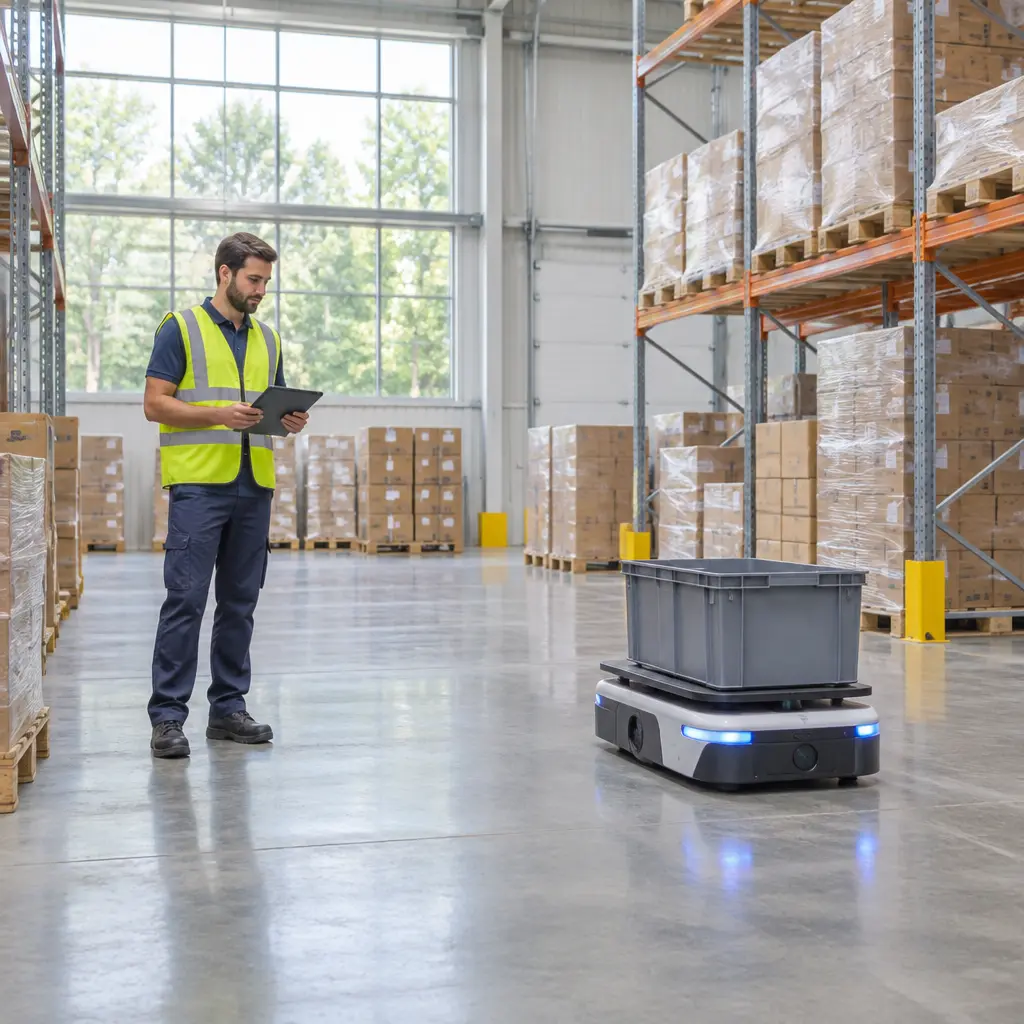
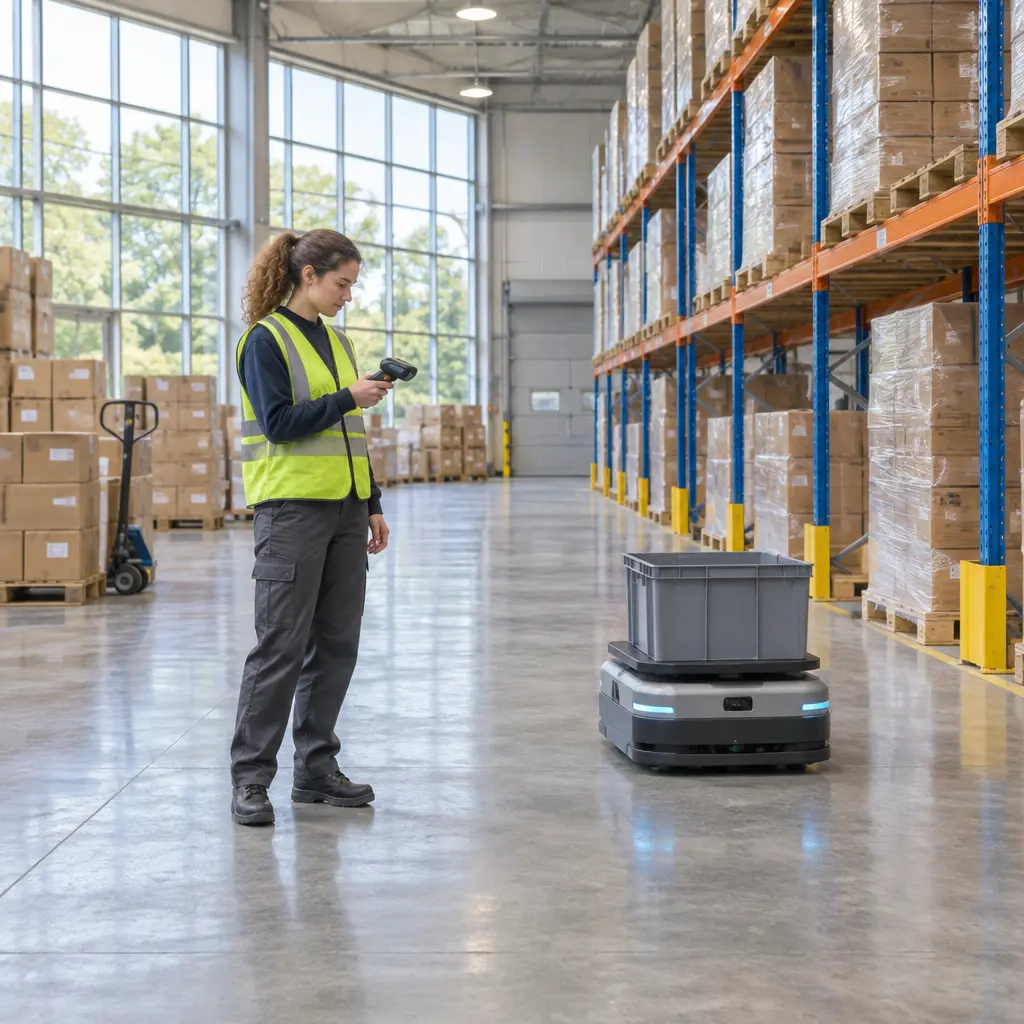
Automated guided vehicles (AGVs) generally follow predefined paths or guidance infrastructure. Autonomous mobile robots (AMRs) use onboard sensing and navigation to move through changing environments, though their capabilities and autonomy vary by model. Robotic arms can assist with depalletizing, palletizing, case handling, or piece picking. These technologies can reduce repeated travel and handling, but they still require human oversight, exception handling, maintenance, and safe operating procedures.
The International Federation of Robotics reported that sales of professional service robots for transportation and logistics grew 35% in 2023, to nearly 113,000 units worldwide. This is evidence of expanding adoption, not a guarantee of savings for any individual facility. A site should test robot performance against real aisles, loads, traffic patterns, and peak operating conditions before scaling deployment.
Warehouse automation changes productivity, accuracy, and workplace safety
Automation matters when it improves a measurable operational outcome without creating unacceptable cost or risk. Potential benefits include shorter travel distances, more consistent task execution, better inventory visibility, and the ability to sustain throughput during demand peaks. Results depend on the starting process: automating a poorly designed workflow may simply make its inefficiencies happen faster.
Throughput and order fulfillment
Throughput is the volume of work completed in a given period, such as order lines picked per hour or cartons shipped per shift. Goods-to-person systems, conveyors, and coordinated task assignment can reduce unproductive walking and move orders through a facility more consistently. The appropriate baseline should include order mix, shift patterns, peak volumes, and service-level requirements rather than relying on a single headline rate.
E-commerce intensifies the challenge because facilities may need to process many small orders alongside larger replenishment flows. The Census Bureau’s 2024 estimate of $1.19 trillion in U.S. e-commerce sales provides context for the scale of that channel, but warehouse demand varies by product category and business model. A retailer should model its own order profiles before choosing between batch picking, zone picking, goods-to-person automation, or a hybrid approach.
Inventory accuracy and traceability
Barcode scanning, radio-frequency identification (RFID), sensors, and WMS transaction controls help record where goods are and when they move. Better visibility can support replenishment, cycle counting, recalls, and order allocation. The benefit depends on disciplined scanning or sensing at key process points; automation cannot create trustworthy inventory records from incomplete or inaccurate inputs.
A practical validation measure is inventory record accuracy: the share of sampled records that match physical stock and location. Other useful indicators include mis-pick rate, order completeness, and inventory adjustments. Facilities should establish a baseline, define how each metric is calculated, and compare results after implementation while accounting for changes in volume and product mix.
Ergonomics and worker safety
Automation can reduce some repetitive lifting, carrying, and long-distance walking, but it can also introduce hazards involving moving machinery, traffic interaction, pinch points, and maintenance work. OSHA identifies material handling and ergonomics as important areas for workplace hazard prevention. Employers therefore need risk assessments, guarding, training, clear pedestrian routes, lockout procedures, and an effective process for reporting near misses.
Safety should be designed into the process rather than treated as a final equipment check. For example, an AMR deployment needs defined operating zones, behavior for blocked paths, emergency stops, and procedures for interactions between people and machines. The relevant measure is not simply how much labor a system replaces, but whether the redesigned task reduces exposure while maintaining safe human control.
Warehouse automation requires a business case and careful implementation
Automation is a capital and operating decision, not a technology purchase in isolation. Total cost can include equipment, software, integration, building changes, training, maintenance, spare parts, and downtime. Benefits may include labor-hour savings, increased capacity, fewer errors, improved space use, or avoided expansion. A credible business case compares these costs and benefits over the system’s useful life and tests assumptions under realistic demand scenarios.
Choosing technology for the process
Technology selection begins with process mapping and operational data. Teams should understand SKU count, item dimensions, order lines, seasonality, travel paths, peak demand, and exception rates. A high-volume, stable operation may justify fixed automation; a variable operation may benefit more from modular robots or process improvements that preserve flexibility.
- Define the operational problem and establish baseline measures.
- Compare manual, semi-automated, and fully automated alternatives.
- Evaluate integration, cybersecurity, safety, maintenance, and vendor support.
- Pilot with representative products and peak-like operating conditions.
- Scale only after confirming service, cost, and safety outcomes.
Integration, resilience, and change management
Automated equipment must exchange accurate instructions and status information with warehouse and business systems. Integration planning should cover data ownership, interfaces, testing, fallback procedures, and cybersecurity. Resilience also matters: a facility should know how it will operate during software outages, equipment failures, or network interruptions.
Workers need training for changed tasks, system exceptions, equipment interaction, and maintenance escalation. Involving employees early can reveal practical obstacles that may not appear in a vendor demonstration. The most effective implementations often combine automation with process redesign and workforce development rather than treating technology as a substitute for operational knowledge.
Warehouse automation is most effective when measured as a system
Warehouse automation links people, processes, software, and equipment to move goods more reliably. Its relevance is reinforced by the scale of e-commerce and logistics employment, while robotics adoption shows that businesses are actively investing in automated transport. Yet no single technology guarantees higher performance: outcomes depend on data quality, process fit, integration, safety, and continuing support.
Before investing, warehouse leaders should document current performance, identify the constraint they intend to solve, and compare realistic alternatives. Track throughput, order accuracy, inventory accuracy, safety indicators, downtime, and total cost before and after deployment. Further reading from the International Federation of Robotics, OSHA, and the U.S. Census Bureau can help frame technology adoption, workplace safeguards, and market context.
Sources: International Federation of Robotics, World Robotics 2024 Service Robots, https://ifr.org/ifr-press-releases/news/service-robots-see-robust-growth-worldwide; U.S. Bureau of Labor Statistics, Occupational Outlook Handbook: Hand Laborers and Material Movers, https://www.bls.gov/ooh/transportation-and-material-moving/hand-laborers-and-material-movers.htm; U.S. Census Bureau, Quarterly Retail E-Commerce Sales, Fourth Quarter 2024, https://www.census.gov/retail/mrts/www/data/pdf/ec_current.pdf; Occupational Safety and Health Administration, Materials Handling and Storage, https://www.osha.gov/materials-handling; Occupational Safety and Health Administration, Ergonomics, https://www.osha.gov/ergonomics; International Federation of Robotics, Logistics Robots, https://ifr.org/service-robots.