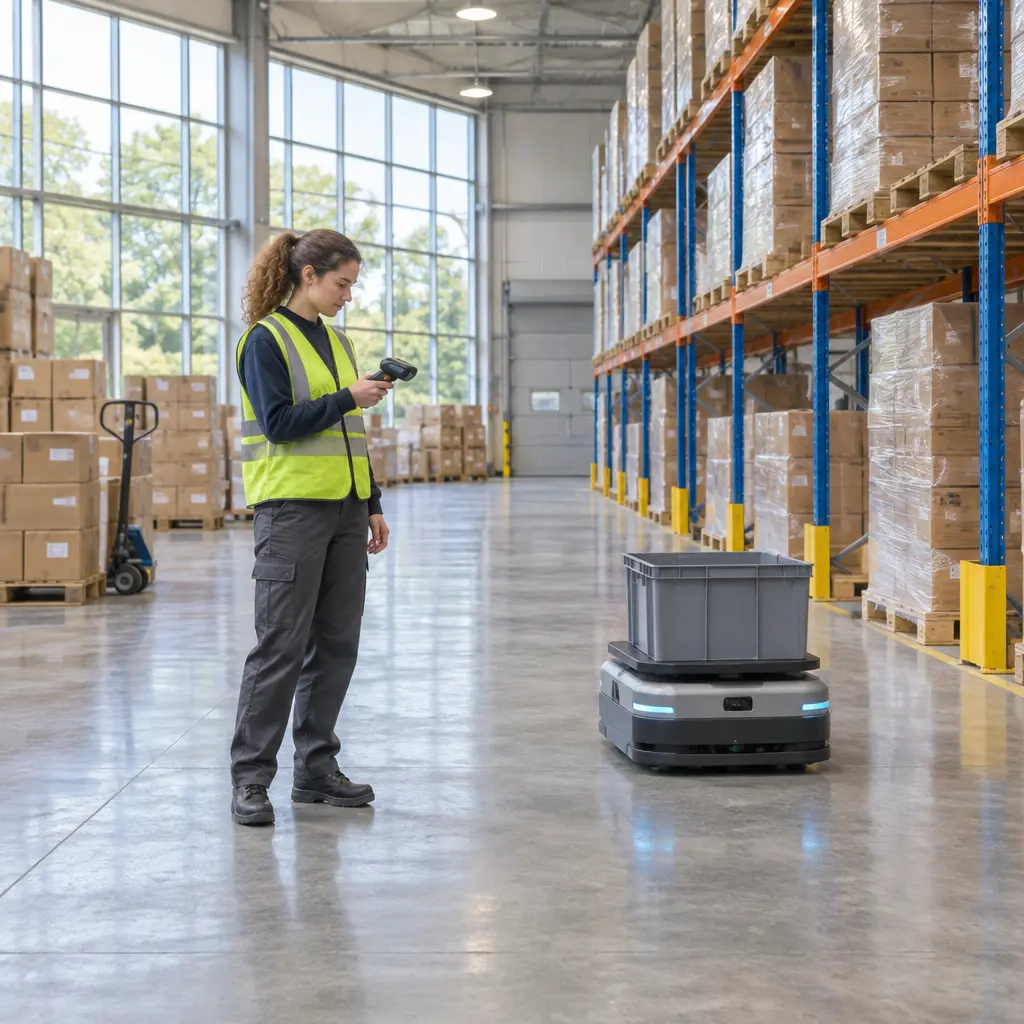
Warehouse automation is the use of equipment and software to move, store, pick, pack, and track goods with less manual effort. For small and mid-sized businesses (SMBs), it does not have to mean a fully robotic warehouse: affordable entry points include barcode-based inventory control, warehouse management software, pick-to-light tools, conveyor upgrades, and selective use of autonomous mobile robots. The right starting point depends on order volume, labor constraints, error rates, and the layout of the facility. These options matter as e-commerce and customer expectations put pressure on fulfillment speed: the U.S. Census Bureau reported that U.S. retail e-commerce sales reached $1.19 trillion in 2024, or 16.1% of total retail sales. A staged approach can help SMBs improve accuracy and throughput while limiting upfront cost and operational disruption.
Warehouse Automation Defines Practical SMB Entry Points
Warehouse automation is the application of technology to warehouse tasks that would otherwise be performed manually or coordinated through paper-based processes. The Association for Advancing Automation describes automation broadly as the use of technology to perform tasks with reduced human intervention. In a warehouse, that can range from scanning a barcode to deploying mobile robots; it does not require a lights-out facility.
For an SMB, an affordable entry point is a bounded project that addresses a measurable bottleneck and can be expanded if it works. Typical measures include inventory accuracy, order-picking time, lines picked per labor hour, mis-shipment rates, and time spent locating stock. The U.S. Bureau of Labor Statistics reported a median annual wage of $37,680 for hand laborers and material movers in May 2023, illustrating why labor productivity is a relevant consideration—though automation should be evaluated against the full cost of implementation, not wages alone.
The main entry-point categories are digital process control, assisted picking and packing, material-handling equipment, and robotics. These options differ in cost, complexity, and suitability, so a sensible sequence usually begins with process visibility before adding machines.
Digital automation: barcodes and warehouse management systems
Digital automation uses software and data-capture tools to guide warehouse work. A barcode scanner paired with inventory software can record receipts, transfers, picks, and shipments as they occur. A warehouse management system (WMS) organizes these transactions and may direct workers to storage locations, allocate orders, and flag replenishment needs.
This is often the most accessible starting point because it can improve the reliability of existing operations without requiring a major building redesign. Before buying a WMS, businesses should check integration with their accounting, enterprise resource planning, e-commerce, and shipping systems; confirm how product and location data will be cleaned; and calculate recurring costs such as licenses, support, scanners, and training. Software alone will not correct inaccurate item records or inconsistent receiving practices.
Assisted picking and packing
Assisted picking uses technology to help a worker identify the next item or location. Examples include pick-to-light indicators, voice-directed instructions, wearable scanners, and mobile picking applications. Packing stations can likewise use scales, dimensioners, and software prompts to verify quantities, select packaging, or print labels.
These tools are most useful when workers spend substantial time reading lists, walking, checking items, or correcting packing mistakes. They are generally less disruptive than a fixed automated system, but their value depends on order patterns, layout, connectivity, and reliable product-location data. A pilot in one zone or for one product family can reveal whether the approach reduces travel or error rates before it is extended across the facility.
Material handling: conveyors and lift assistance
Material-handling automation moves goods through a facility with equipment such as conveyors, powered roller sections, pallet lifts, and ergonomic lift tables. These systems can reduce repeated carrying and help connect receiving, storage, picking, and packing areas. A short conveyor serving a busy packing line may be a more appropriate first investment than a complex, facility-wide installation.
The Occupational Safety and Health Administration identifies material handling as an area with ergonomic risks, including lifting, carrying, and repetitive movement. Equipment selection should therefore consider both productivity and worker safety. Businesses need to assess traffic routes, emergency access, guarding, maintenance, and the possibility that a conveyor could simply move a bottleneck to another process.
Autonomous mobile robots and goods-to-person systems
Autonomous mobile robots (AMRs) navigate warehouse floors to transport goods, carts, or shelving between locations. Goods-to-person systems bring inventory to a stationary worker, reducing the need to walk to each storage location. These technologies can be introduced as targeted systems, but they require more planning than scanners or software because they depend on floor conditions, safe routes, charging, system integration, and ongoing technical support.
The International Federation of Robotics reported that 2023 sales of professional service robots for transportation and logistics grew 35% year over year, reaching nearly 113,000 units worldwide. That figure reflects broader adoption, not a guarantee that a robot will pay off for any individual SMB. A company should first test whether travel is a dominant share of picking time and obtain a vendor estimate that includes implementation, software, maintenance, batteries, and worker training.
Warehouse Automation Matches Investment to the Bottleneck
Choosing a technology begins with understanding the work, not selecting a machine. The U.S. Small Business Administration’s guidance on business planning emphasizes examining costs and market conditions before committing resources; the same discipline applies to warehouse projects. Establish a baseline, identify the process causing delay or errors, and estimate the total cost of addressing it.
Inventory inaccuracies point to scanning and process control
If stock records frequently disagree with physical counts, start by reviewing receiving, put-away, transfers, returns, and cycle-count procedures. Barcode scanning and a WMS can make transactions visible and reduce reliance on memory or delayed data entry. However, the business should define standard operating procedures and assign responsibility for exceptions; otherwise, errors may simply be recorded more consistently.
Long picking routes point to layout and travel reduction
When workers spend much of a shift walking, businesses can first test low-cost changes such as relocating fast-moving items, grouping products commonly ordered together, or using batch and zone picking. If travel remains a major constraint, carts, conveyor sections, or AMRs may be evaluated. A time-and-motion study or a sample of order paths can help determine whether the expected savings justify equipment costs.
Frequent packing errors point to verification
If wrong quantities, items, or labels are a recurring problem, scan-to-verify workflows, weighing, or packing prompts may be more appropriate than automating the entire pick process. Track error rates and rework before and after a pilot, and include customer returns and reshipping costs when calculating the benefit. Improving verification can have value even when order volumes are too low to support advanced robotics.
Seasonal peaks point to flexible capacity
Businesses with strong seasonal swings should compare permanent equipment with flexible approaches, such as temporary labor, adjustable workstations, modular conveyors, or robotics offered through a subscription or robotics-as-a-service arrangement. A flexible model may lower upfront expenditure, but contracts, minimum usage, service response, and exit terms matter. Peak-season pilots should be planned early enough to test systems before the busiest period.
Warehouse Automation Controls Cost and Implementation Risk
An affordable purchase price does not necessarily mean a low total cost. The relevant comparison includes equipment or subscription fees, integration, facility changes, maintenance, training, downtime, and the time needed to manage the project. A phased plan reduces risk by tying each investment to operational evidence.
Build a baseline and a simple business case
Record current performance before a pilot. Useful measures include orders or lines processed per hour, inventory variance, picking and packing error rates, labor hours per order, on-time shipment rate, and safety incidents. Compare these against the same measures after implementation, accounting for changes in volume and product mix.
A basic payback estimate is the initial project cost divided by expected net annual savings. Net savings should account for maintenance, software, support, and new operating expenses, not just labor reductions. The calculation should also distinguish cash savings from capacity gains: additional throughput may be valuable even when it does not immediately reduce payroll, but that benefit should be stated clearly.
Pilot one workflow before scaling
A pilot limits the consequences of an incorrect assumption. Select a contained workflow—such as receiving a product group, replenishing one zone, or verifying packing—and define success criteria in advance. Include frontline employees in the design, test exceptions as well as normal orders, and confirm that the system works with actual facility conditions and business software.
Plan integration, cybersecurity, and worker training
Automation connects operational technology, software, networks, and business records. Before purchase, document which systems exchange data, who owns that data, how access is controlled, and what happens if a network or vendor service becomes unavailable. The National Institute of Standards and Technology’s cybersecurity guidance recommends managing security risks throughout the system life cycle; SMBs should ask vendors about updates, backups, user permissions, and incident support.
Training should cover daily use, error recovery, safety, and maintenance escalation. A system that workers do not trust or understand can create workarounds that undermine data quality. Explain how roles may change, gather feedback during the pilot, and provide time for practice before performance is judged.
Warehouse Automation Shows Value in Staged Real-World Adoption
A common SMB pathway is to digitize transactions first, then improve work methods, and finally automate physical movement where measurements justify it. For example, a distributor could begin with barcode receiving and cycle counts, use order data to reorganize fast-moving stock, add scan verification at packing, and assess an AMR only if travel remains a proven constraint. This sequence creates cleaner data for later investments and avoids buying equipment to compensate for unclear processes.
Publicly available case studies often describe large deployments and should not be treated as direct forecasts for a smaller warehouse. The transferable lesson is to connect technology to a specific operating objective, such as reducing search time or increasing order capacity, and to validate results in the organization’s own conditions. A useful chart for an internal review would compare baseline and pilot results for order lines per hour, error rate, and total cost per order, with separate annotations for volume and staffing changes.
Conclusion: Warehouse Automation Starts with Measurable, Affordable Steps
Warehouse automation for SMBs spans barcode and WMS tools, assisted picking, material-handling equipment, and mobile robotics. Digital controls are often a practical first step; picking aids and conveyors can target specific workflow constraints; and AMRs or goods-to-person systems may suit operations where measured travel and volume support the investment. The strongest implementation begins with a defined bottleneck, a reliable baseline, a limited pilot, and a full-cost review.
As e-commerce expands and labor, accuracy, and delivery expectations remain important, incremental automation can help smaller businesses build capacity without committing immediately to a fully automated facility. Start by measuring one process, consult employees who perform the work, and request vendor proposals that disclose integration and ongoing costs. Then scale only when the pilot demonstrates a result worth repeating.
Sources: U.S. Census Bureau, Quarterly Retail E-Commerce Sales, Fourth Quarter 2024, https://www.census.gov/retail/mrts/www/data/pdf/ec_current.pdf; U.S. Bureau of Labor Statistics, Occupational Employment and Wage Statistics, Hand Laborers and Material Movers, May 2023, https://www.bls.gov/oes/2023/may/oes537064.htm; Association for Advancing Automation, What Is Automation?, https://www.automate.org/robotics/what-is-robotics; International Federation of Robotics, World Robotics 2024 Service Robots, https://ifr.org/ifr-press-releases/news/service-robots-see-35-growth-worldwide; Occupational Safety and Health Administration, Materials Handling and Storage, https://www.osha.gov/materials-handling; U.S. Small Business Administration, Market Research and Competitive Analysis, https://www.sba.gov/business-guide/plan-your-business/market-research-competitive-analysis; National Institute of Standards and Technology, Cybersecurity Framework 2.0, https://www.nist.gov/cyberframework.