Warehouse automation is the use of equipment, software, and data systems to perform or support tasks such as moving goods, storing inventory, picking orders, and managing warehouse operations. It is changing modern warehouses by combining robotics, automated storage, and software with human work—not simply replacing people. The shift matters as e-commerce and delivery expectations increase: the U.S. Census Bureau reported that e-commerce accounted for 16.1% of U.S. retail sales in the fourth quarter of 2024. This article explains the main automation technologies, their operational and workforce effects, implementation challenges, and practical steps for adopting them.
Warehouse Automation Technologies and Their Characteristics
Warehouse automation refers to technologies that execute or coordinate logistics activities with limited manual intervention. The International Federation of Robotics describes logistics robots as systems used to transport and handle goods in settings such as warehouses. In practice, the category includes both physical equipment and the software that directs it. Automation ranges from a barcode scanner that guides a worker to a fully integrated facility where machines move, store, retrieve, and sort products.
Common characteristics include repeatable task execution, integration with inventory and order data, and the ability to increase throughput or consistency. The right technology depends on product dimensions, order profiles, building layout, labor availability, and expected demand. A robot or conveyor is not automatically more efficient: poorly matched equipment can create bottlenecks or leave capacity unused.
Automated Storage and Retrieval Systems
An automated storage and retrieval system (AS/RS) uses equipment such as cranes, shuttles, lifts, or robotic systems to store and retrieve goods from designated locations. These systems can make better use of vertical space and bring inventory to a picking station, reducing the need for workers to travel through aisles. AS/RS designs vary from systems handling pallets to high-density solutions for bins or cartons.
Their performance depends on factors including storage density, retrieval speed, product mix, and system availability. The Material Handling Institute identifies AS/RS as a family of technologies rather than a single machine type. That distinction is important: a pallet-handling system and a goods-to-person shuttle address different storage and order-picking needs.
Conveyors, Sortation, and Automated Guided Vehicles
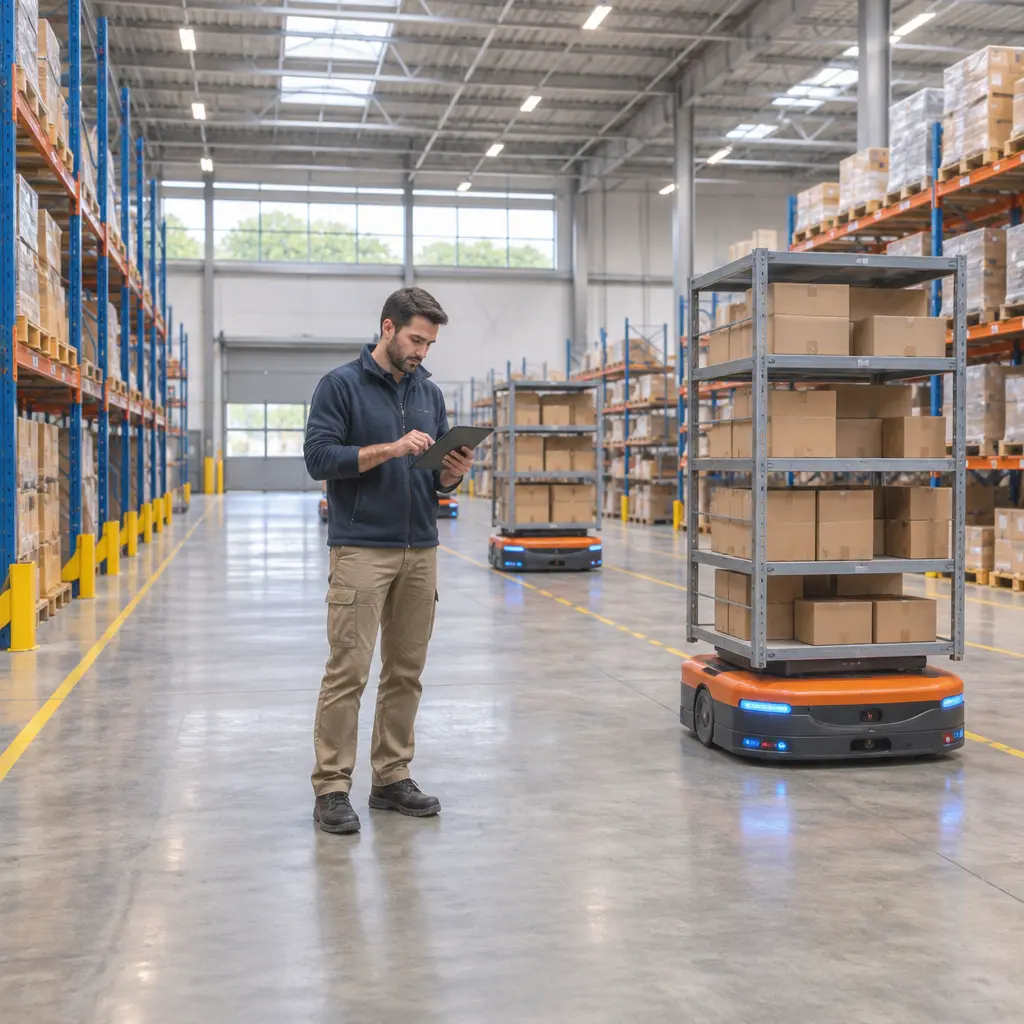
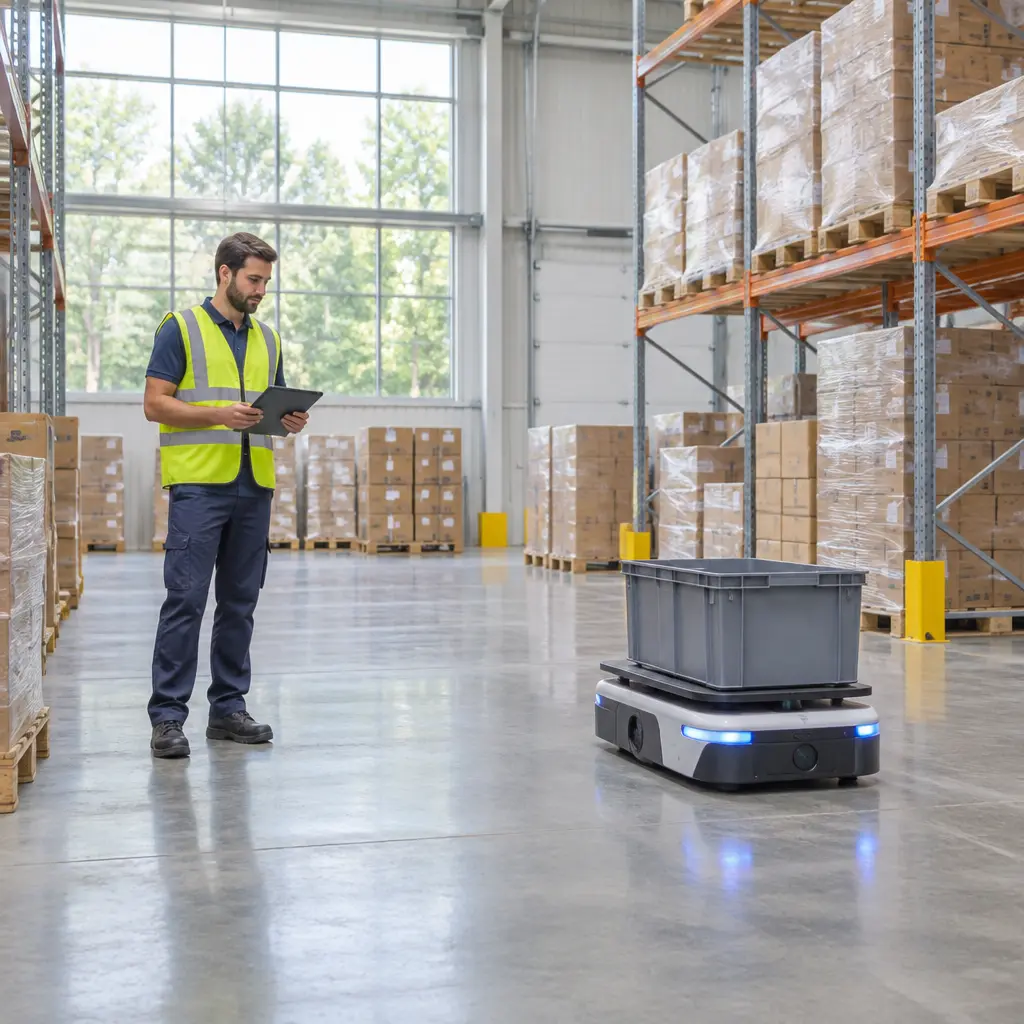
Conveyors and sortation equipment move products along fixed routes and direct them to destinations such as packing stations, shipping lanes, or store orders. Automated guided vehicles (AGVs) follow defined routes using guidance systems, while autonomous mobile robots (AMRs) use sensors and onboard navigation to move through changing environments. These technologies can reduce manual transport and connect separate warehouse processes.
The choice between fixed infrastructure and mobile equipment is a trade-off. Conveyors can provide predictable, high-volume movement but are less flexible when layouts change. AGVs and AMRs can be easier to reassign, though they require traffic management, charging plans, and safe interaction with people. The Occupational Safety and Health Administration emphasizes that employers must assess hazards and establish safeguards when workers operate near automated equipment.
Warehouse Management and Robotics Software
A warehouse management system (WMS) records inventory and coordinates activities such as receiving, replenishment, picking, and shipping. Warehouse control systems and fleet-management software translate operational decisions into instructions for conveyors, robots, and other machinery. Robotics software may also assign tasks, manage routes, and report equipment status.
Software integration is essential because physical automation depends on accurate information. If a WMS shows an item in the wrong location, a robot can efficiently retrieve the wrong stock—or fail to complete the task. GS1 standards for identification and data exchange help organizations structure product and logistics information, while reliable master data and system interfaces support traceability across warehouse operations.
Warehouse Automation Changes Productivity and Order Fulfillment
Automation changes productivity by reducing avoidable travel, standardizing repetitive work, and coordinating tasks across the warehouse. It can also improve fulfillment consistency, but results depend on implementation, product mix, and operational discipline. Industry estimates should be treated cautiously: vendor case studies may describe specific facilities and are not guarantees that another warehouse will achieve the same gains.
Goods-to-Person Picking and Faster Fulfillment
In goods-to-person picking, automated equipment brings inventory to a stationary or semi-stationary worker, rather than requiring the worker to walk to each storage location. This approach can reduce walking and make picking more predictable, particularly in operations with many small orders. Pick-to-light displays, voice systems, and handheld devices can further guide the worker and verify item selection.
The potential benefit is especially relevant as online orders increase in volume and complexity. The U.S. Census Bureau’s fourth-quarter 2024 estimate put e-commerce at 16.1% of retail sales, with online sales totaling approximately $308.9 billion for that quarter. These figures describe retail activity, not warehouse automation adoption, but they help explain why many operators are investing in faster, more accurate fulfillment processes.
Inventory Accuracy and Operational Visibility
Automated scanning, sensors, and system-directed handling can improve inventory visibility by recording movements as they occur. Accurate records help reduce misplaced stock, support replenishment, and make it easier to investigate discrepancies. A WMS can also show managers where work is accumulating, allowing them to adjust labor or release orders in a more controlled way.
Visibility is not the same as accuracy. Systems need consistent item identification, disciplined receiving and returns processes, and routine checks. The GS1 system of standards supports identification of products and logistics units, but organizations must still ensure that labels are readable and scans are captured at the correct process steps.
Consistency, Capacity, and Peak-Demand Resilience
Automated systems can perform repetitive movements consistently and operate for extended periods, helping warehouses handle surges such as seasonal promotions. Modular robotics may allow capacity to be added incrementally, while fixed systems can deliver high throughput when demand is stable and predictable. Resilience, however, requires contingency plans for equipment faults, software outages, and power interruptions.
Automation should therefore be measured using operational metrics such as orders per labor hour, lines picked per hour, order accuracy, cycle time, equipment uptime, and cost per order. Comparing these measures before and after deployment—and accounting for order mix and seasonal changes—provides a more credible assessment than relying on a headline productivity claim.
Warehouse Automation Reshapes Jobs, Skills, and Safety
Automation changes the tasks people perform, the skills employers need, and how safety is managed. It can remove some physically demanding or repetitive activities while creating demand for workers who maintain equipment, analyze data, supervise systems, and resolve exceptions. Outcomes differ by facility and technology; automation does not eliminate the need for human judgment, coordination, or problem-solving.
Changing Roles and Workforce Skills
As automated systems take on routine movement and handling, warehouse roles may shift toward equipment operation, troubleshooting, inventory control, and process monitoring. Workers may need training in human-machine interaction, digital work instructions, basic diagnostics, and safe response to system alerts. Employers that involve workers early can draw on their operational knowledge to identify practical problems before deployment.
The broader labor context is significant. The U.S. Bureau of Labor Statistics projected 6% employment growth for material moving occupations from 2022 to 2032, while also noting that automation may affect demand and job duties across parts of the sector. Projections are not a forecast for every warehouse or job title, but they underscore the importance of planning for changing skill requirements rather than treating workforce transition as an afterthought.
Worker Safety and Human-Robot Collaboration
Safety in an automated warehouse includes managing vehicle traffic, guarding machinery, controlling access to hazardous zones, and training workers to respond to faults. Mobile robots and people may share space, so facilities need clear traffic rules, marked walkways, speed controls, and procedures for stopping or isolating equipment. Maintenance tasks require particular care because workers may encounter stored energy or moving machinery.
OSHA’s guidance on robotics and machine guarding stresses hazard assessment and appropriate safeguards. Employers should review equipment risk assessments, emergency stops, lockout/tagout procedures, and worker training before commissioning a system and whenever layouts or processes change. Safety performance should be monitored alongside productivity so that faster throughput does not come at the cost of increased exposure to hazards.
Warehouse Automation Creates Investment and Integration Challenges
Automation can require substantial capital, facility changes, systems integration, and ongoing technical support. A business case should consider the total cost of ownership—not just the purchase price—including installation, software, maintenance, energy, training, downtime, and future upgrades. A solution that works well for one warehouse may be unsuitable for another with different inventory, order patterns, or building constraints.
Capital Costs and Return on Investment
Return on investment (ROI) compares the financial benefits of an investment with its costs over a defined period. For warehouse automation, benefits may include reduced travel, fewer handling errors, better space utilization, or greater capacity; costs include equipment, integration, service, and operational disruption during installation. Companies should model several demand scenarios and test assumptions about labor, throughput, uptime, and maintenance.
A pilot or phased deployment can reduce risk by validating assumptions in a limited area before wider rollout. For example, an operator might first automate replenishment or a high-volume picking zone, then compare results with a control area. The evaluation should include service quality and safety, not only labor savings, and should document what happens when equipment is unavailable.
Legacy Systems, Data, and Cybersecurity
Integration connects automation equipment with the WMS, enterprise resource planning software, order systems, and facility controls. Older systems may lack compatible interfaces, while inconsistent item and location data can undermine performance. Before deployment, organizations should map data flows, clarify which system owns each record, and test error handling and recovery procedures.
Connected equipment also introduces cybersecurity and continuity concerns. NIST’s cybersecurity guidance recommends a risk-based approach that includes identifying assets, protecting systems, detecting incidents, responding, and recovering. Warehouse operators can apply these principles through access controls, network segmentation, software updates, backups, vendor security reviews, and documented manual workarounds for critical processes.
Facility Fit, Maintenance, and Scalability
Facility fit covers floor loading, ceiling height, aisle widths, fire protection, charging locations, and the movement of people and goods. Equipment must also be maintainable: spare parts, service response times, technician training, and planned maintenance all affect uptime. A system that is difficult to repair can turn a small failure into a major fulfillment interruption.
Scalability means the system can accommodate future changes in volume, product range, or layout without disproportionate cost. Modular designs can support incremental expansion, but only when software, power, floor space, and operational processes can support added capacity. A sound facility assessment should identify both current constraints and the likely changes the warehouse must handle over the investment’s life.
Warehouse Automation Works Best Through Phased Implementation
Successful automation begins with an operational problem, not a technology purchase. The operator should establish baseline performance, identify process constraints, and select a solution that addresses measurable needs. Cross-functional planning involving warehouse operations, IT, engineering, safety, finance, and frontline workers helps ensure the design fits real workflows.
- Map current processes and record baseline measures, including throughput, accuracy, labor hours, downtime, and safety incidents.
- Match the technology to the task, product profile, and facility rather than assuming one automation type fits every operation.
- Test integration, exception handling, worker procedures, and equipment recovery in a pilot environment.
- Train employees and supervisors before go-live, with clear procedures for both normal operation and system failures.
- Review results against agreed targets and scale only when performance, safety, and cost assumptions are validated.
A useful illustration is a goods-to-person deployment: the operator can track walking distance, picks per hour, mis-picks, queue time, system uptime, and employee feedback before and after installation. A chart comparing these indicators across the pilot period would show whether faster picking is accompanied by improved accuracy and acceptable reliability. The same measurement discipline applies to mobile robots, automated sortation, and inventory-control systems.
Conclusion: Warehouse Automation Is a Strategic Operating Choice
Warehouse automation encompasses storage and retrieval equipment, conveyors, mobile robots, picking technologies, and the software that coordinates them. These tools can improve fulfillment speed, inventory visibility, consistency, and capacity, while also changing workforce skills and safety requirements. Their value depends on sound integration, facility fit, reliable data, cybersecurity, maintenance, and a realistic business case.
As e-commerce and service expectations continue to influence logistics, warehouse leaders should assess where automation can solve a defined operational problem and where human expertise remains essential. Start with baseline measures, consult workers, test solutions in phases, and evaluate productivity alongside cost, accuracy, safety, and resilience. Further reading from the U.S. Census Bureau, OSHA, NIST, and the Material Handling Institute can help organizations ground decisions in current data and practical guidance.
Sources: U.S. Census Bureau, Quarterly Retail E-Commerce Sales, Fourth Quarter 2024, https://www.census.gov/retail/mrts/www/data/pdf/ec_current.pdf; International Federation of Robotics, World Robotics 2024 Service Robots, https://ifr.org/ifr-press-releases/news/service-robots-see-double-digit-growth-worldwide; Material Handling Institute, Automated Storage and Retrieval Systems, https://www.mhi.org/fundamentals/automated-storage-retrieval-systems; Occupational Safety and Health Administration, Robotics, https://www.osha.gov/robotics; GS1, Standards, https://www.gs1.org/standards; U.S. Bureau of Labor Statistics, Occupational Outlook Handbook: Material Moving Occupations, https://www.bls.gov/ooh/transportation-and-material-moving/material-moving-occupations.htm; National Institute of Standards and Technology, Cybersecurity Framework, https://www.nist.gov/cyberframework.