Warehouse automation is the use of technology and equipment to perform or support warehouse tasks such as receiving, storing, picking, packing, sorting, and shipping. By coordinating software, data, and physical systems, automation can help warehouses move orders faster, reduce avoidable errors, and make better use of labor and space. Its value is increasingly important as fulfillment expectations rise: the 2024 MHI Annual Industry Report found that 55% of surveyed supply-chain professionals planned to increase investment in supply-chain technology and innovation. The best results come from matching tools to the work, integrating them with warehouse management systems, and measuring performance rather than automating for its own sake.
How warehouse automation improves order speed
Warehouse automation improves order speed by reducing the time and movement required to complete each fulfillment step. The term covers a range of systems, from barcode scanning and conveyor belts to autonomous mobile robots and automated storage and retrieval systems. The International Federation of Robotics describes logistics robots as systems used to transport goods and materials, including in warehouses. In practice, warehouse automation is not one machine: it is a combination of equipment, software, process design, and human oversight.
Speed depends on the whole order path. Faster picking alone may not help if packing, replenishment, or shipping remains a bottleneck. A useful way to visualize the impact is a process-time chart comparing order release, picking, consolidation, packing, and dispatch before and after automation. Such a chart should show both average time and variability, since predictable fulfillment is often as important as a faster best-case result.
Automation of picking and order movement
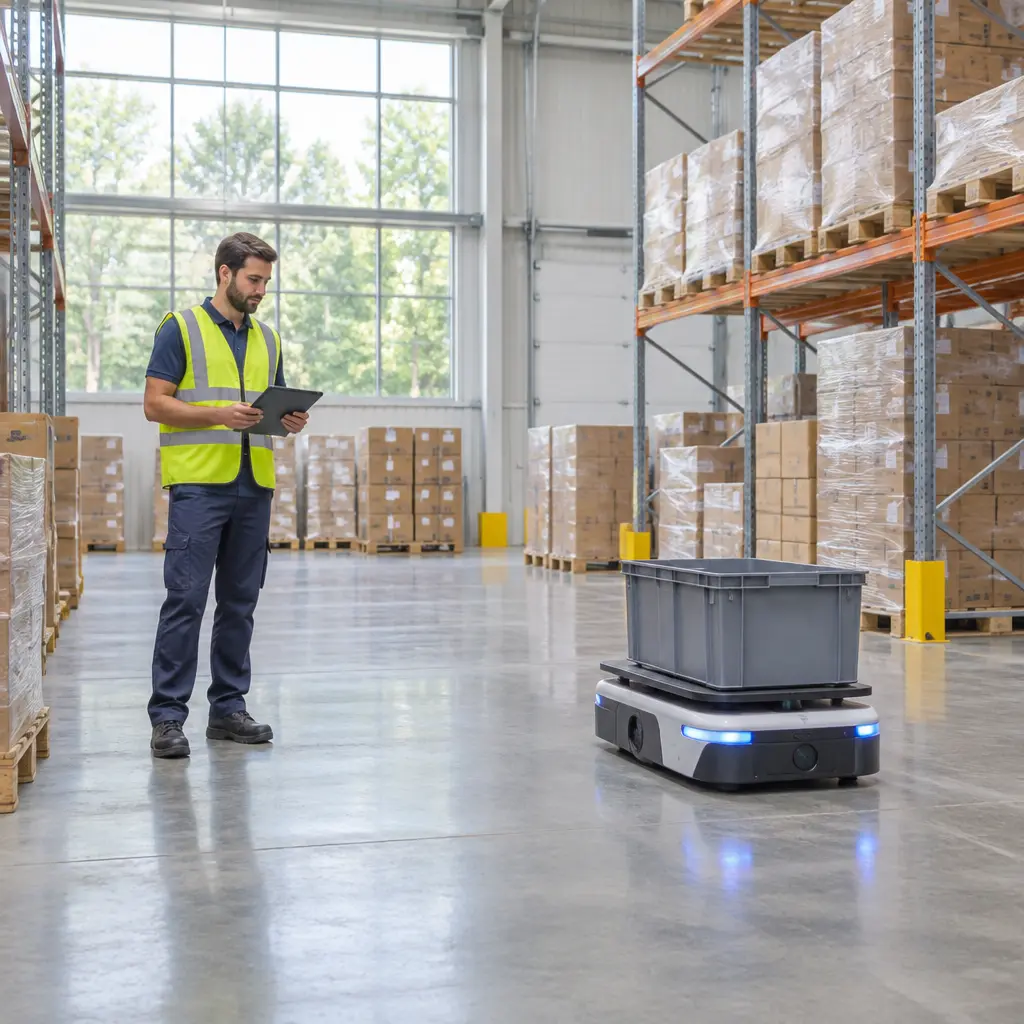
Picking automation brings products to workers or guides people along efficient routes. Goods-to-person systems move totes or shelves to picking stations, while autonomous mobile robots can carry items or carts through a facility. These approaches reduce unnecessary walking and help workers process more order lines in a shift. The exact gain varies by facility, order profile, layout, and system design, so vendor performance claims should be checked against a site-specific pilot.
Amazon’s 2023 report on its operations described using more than 750,000 robots across its network, including systems that move inventory and support employee tasks. The example illustrates how robotics can operate at large scale, but it is not a universal benchmark: businesses with different volumes, products, and building constraints may need simpler solutions such as optimized pick paths or conveyor-assisted zones.
Automation of sorting, packing, and dispatch
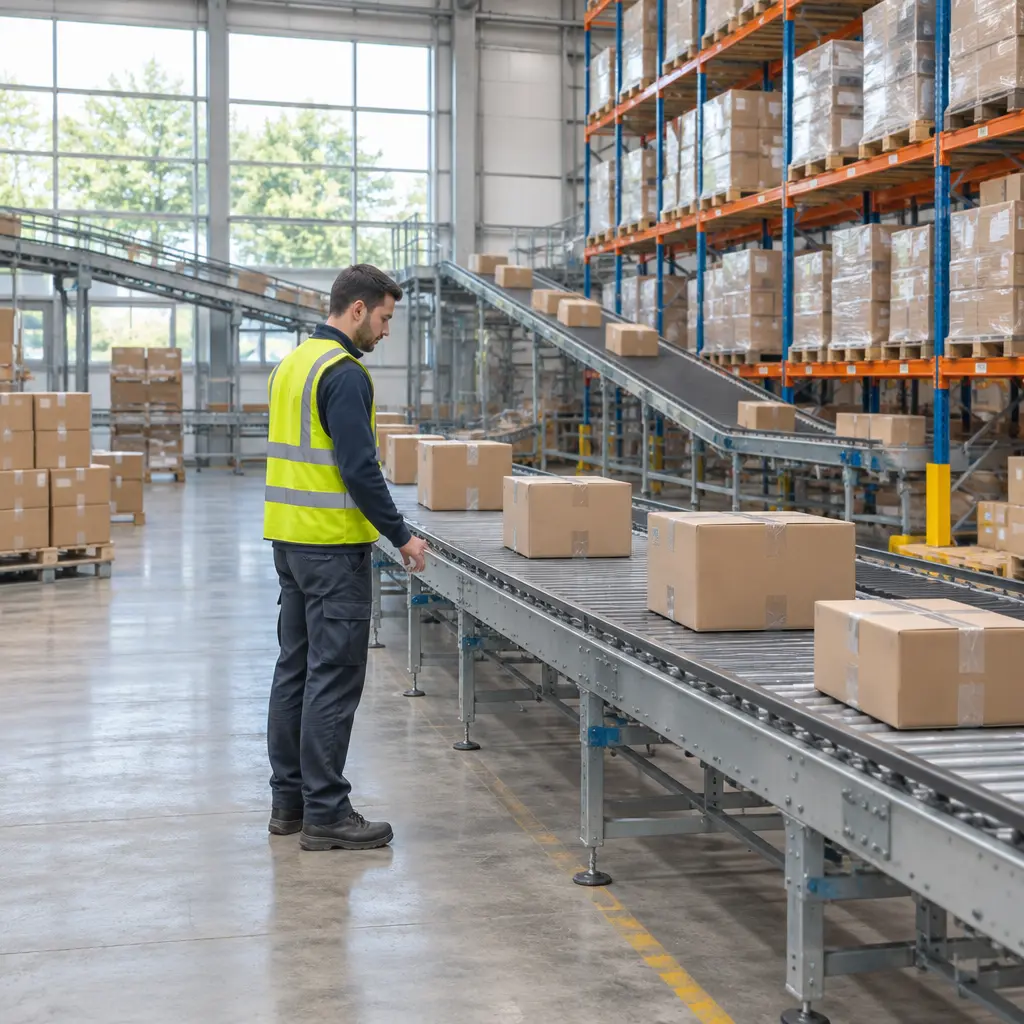
Sortation automation directs orders or packages to the correct packing lane, carrier, or dispatch area. Conveyors, dimensioners, barcode readers, and automated sorters can reduce manual handoffs and make outbound flow more consistent. Packing systems may also automate carton selection, label printing, weighing, and shipping documentation. Together, these tools reduce delays between picking an item and preparing it for carrier collection.
The U.S. Census Bureau’s quarterly e-commerce reporting has documented the continuing importance of online retail to total retail sales. As online orders often involve many small shipments and tight delivery windows, warehouses benefit from systems that can handle order peaks without creating a backlog at packing or dispatch. Automation does not eliminate the need for exception handling: damaged goods, unreadable labels, and incomplete orders still require clear human workflows.
Warehouse automation technologies that support faster fulfillment
The right technology depends on what is slowing orders down. Common categories include warehouse management software, automated storage and retrieval, robotic transport, conveyor and sortation equipment, and data tools that predict workload. These technologies are often combined, but they should be selected according to the facility’s order mix, throughput requirements, available space, and investment capacity.
Warehouse management systems and real-time data
A warehouse management system (WMS) organizes inventory records and directs work such as receiving, replenishment, picking, and shipping. When connected to scanners, automation equipment, and order systems, a WMS can assign tasks based on inventory location, priority, and worker or machine availability. Accurate, timely inventory data helps prevent wasted trips caused by stock being recorded in the wrong location.
Software is the coordination layer, not a substitute for sound processes. Before implementation, a warehouse should verify location data, item dimensions, order rules, and system integrations. The National Institute of Standards and Technology’s work on manufacturing and supply-chain systems emphasizes interoperability and reliable information exchange as important considerations in connected operations.
Automated storage and retrieval systems
Automated storage and retrieval systems (AS/RS) use equipment such as cranes, shuttles, or vertical lift modules to store and retrieve goods. By bringing inventory to a workstation and using storage height efficiently, AS/RS can shorten retrieval time and reduce dependence on manual travel through aisles. These systems are especially relevant where space is constrained or order activity is concentrated in a predictable range of products.
AS/RS performance depends on factors including product dimensions, replenishment frequency, station capacity, and how quickly orders must be consolidated. A design that retrieves items quickly but feeds packing more rapidly than packing can handle will simply move the bottleneck downstream. Capacity planning should therefore consider the full fulfillment sequence, not just storage density or retrieval speed.
Robotics, conveyors, and autonomous mobile robots
Robotics and material-handling equipment automate movement between work areas. Conveyors are effective for stable, repeatable flows, while autonomous mobile robots can adapt routes and transport loads between locations. Collaborative robots may assist with repetitive tasks such as moving cases or presenting products, subject to appropriate risk assessment and safety controls.
The International Federation of Robotics reported that 113,000 professional service robots for transportation and logistics were sold worldwide in 2022, making logistics the largest application category in its professional service robot statistics. This figure shows the scale of adoption, but it does not establish that every warehouse needs robots. A facility should compare the cost and expected throughput of robotics with alternatives such as better slotting, wave planning, or additional conveyor capacity.
How to implement automation without slowing operations
Automation implementation is the process of selecting, integrating, testing, and operating technology within existing warehouse workflows. A phased approach helps protect service levels while teams learn how the new system behaves. The starting point should be a baseline of current performance, followed by a clearly defined operational problem and a measurable pilot.
Map bottlenecks and set performance measures
A bottleneck is the step that limits the throughput of the whole process. Warehouses can identify bottlenecks by tracking order cycle time, lines picked per labor hour, inventory accuracy, on-time shipment rate, and the time orders spend waiting between stages. The Council of Supply Chain Management Professionals’ logistics definitions describe order fulfillment as a connected set of activities, reinforcing why performance should be evaluated across the complete order journey.
Measures should be established before equipment is installed. For example, a pilot can compare a defined group of orders processed with and without a new picking system, while accounting for order size, product type, and shift conditions. This helps distinguish an actual productivity improvement from changes in workload or staffing.
Integrate systems and prepare employees
Integration connects automation equipment with the WMS, order management, inventory, and shipping systems so that each task uses consistent information. Poor integration can create duplicate work, incorrect stock counts, or stalled orders. Testing should include normal transactions as well as exceptions such as short picks, damaged products, network interruptions, and equipment faults.
Employee preparation is equally important. Workers need training in new task flows, safe interaction with equipment, and escalation procedures. The U.S. Occupational Safety and Health Administration advises employers to assess workplace hazards and train workers on equipment risks. In automated facilities, safety planning should address pedestrian routes, robot operating zones, emergency stops, and maintenance lockout procedures.
Scale gradually and plan for resilience
A phased rollout introduces automation in a controlled area before expanding it across the facility. This allows teams to resolve workflow issues, test peak demand, and confirm that maintenance support and spare parts are available. Warehouses should also plan manual fallback procedures for outages so that a single equipment or software failure does not stop every order.
The 2024 MHI report found that 55% of respondents planned to increase investment in supply-chain technology and innovation, while also identifying labor and workforce challenges among industry concerns. This combination makes implementation planning essential: technology can support capacity, but its benefits depend on skilled people, reliable systems, and realistic operating assumptions.
Measuring the impact of warehouse automation
Automation should be evaluated through a balanced set of speed, accuracy, cost, safety, and service measures. An increase in units processed per hour is not a complete success if mispicks, damage, overtime, or late shipments also rise. Managers should compare results to the pre-automation baseline and review performance over enough time to include ordinary variation and peak conditions.
- Order cycle time: elapsed time from order release to shipment or dispatch.
- Throughput: orders, units, or order lines processed in a defined period.
- Picking accuracy: the share of picked items that match the order requirements.
- On-time shipment rate: the proportion of orders shipped by the promised cutoff.
- Labor productivity: output relative to labor hours, interpreted alongside workload and safety.
- Equipment availability: the time automated systems are ready for productive use.
A practical dashboard can compare these measures across shifts, zones, and order types. Managers should also track maintenance costs and the frequency of manual interventions. The goal is not simply to maximize machine utilization; it is to deliver accurate orders reliably and economically.
Conclusion: Automation makes faster fulfillment a system-wide effort
Warehouse automation helps orders move faster when it removes avoidable travel, waiting, and manual handoffs across picking, storage, sorting, packing, and dispatch. WMS platforms, AS/RS, robots, conveyors, and real-time data each address different constraints, so the strongest approach begins with a measured bottleneck rather than a technology trend. Industry investment data and real-world deployments show that automation is becoming a central part of logistics, but results depend on integration, employee training, safety, and thoughtful capacity planning.
Warehouse leaders can begin by mapping order flow, establishing baseline metrics, and piloting one targeted improvement. For further guidance, review the MHI Annual Industry Report, International Federation of Robotics logistics statistics, and OSHA materials on workplace safety before developing a site-specific automation plan.
Sources: MHI, 2024 MHI Annual Industry Report, https://www.mhi.org/publications/report; International Federation of Robotics, World Robotics 2023 Service Robots, https://ifr.org/ifr-press-releases/news/robot-sales-reach-record-levels; Amazon, 2023 Amazon Sustainability Report, https://sustainability.aboutamazon.com/2023-sustainability-report.pdf; U.S. Census Bureau, Quarterly Retail E-Commerce Sales, https://www.census.gov/retail/ecommerce.html; National Institute of Standards and Technology, Smart Manufacturing Systems, https://www.nist.gov/programs-projects/smart-manufacturing-systems; Council of Supply Chain Management Professionals, CSCMP Supply Chain Management Definitions and Glossary, https://cscmp.org/CSCMP/Academia/SCM_Definitions_and_Glossary_of_Terms.aspx; U.S. Occupational Safety and Health Administration, Robotics, https://www.osha.gov/robotics